 Shadow DirectorFrançais
Home › Guides › Negotiating with player agents in a football game
Negotiating with player agents in a football game
Here you do not click “buy”. You talk, test the ground and adapt your tone to the person across the table. This is how negotiation works.
A real conversation, not a button
When you want to sign someone you click Contact the agent from the player card in My club › Recruitment. The negotiation then opens in the office phone as a conversation. At each round the agent answers and offers you three replies, drawn from five registers: Logic, Aggressive, Financial, Charm, Threat.
The same register does not have the same effect depending on who is on the other side: you must read their personality and adjust. When the price is agreed the player joins the squad and the fee is debited.
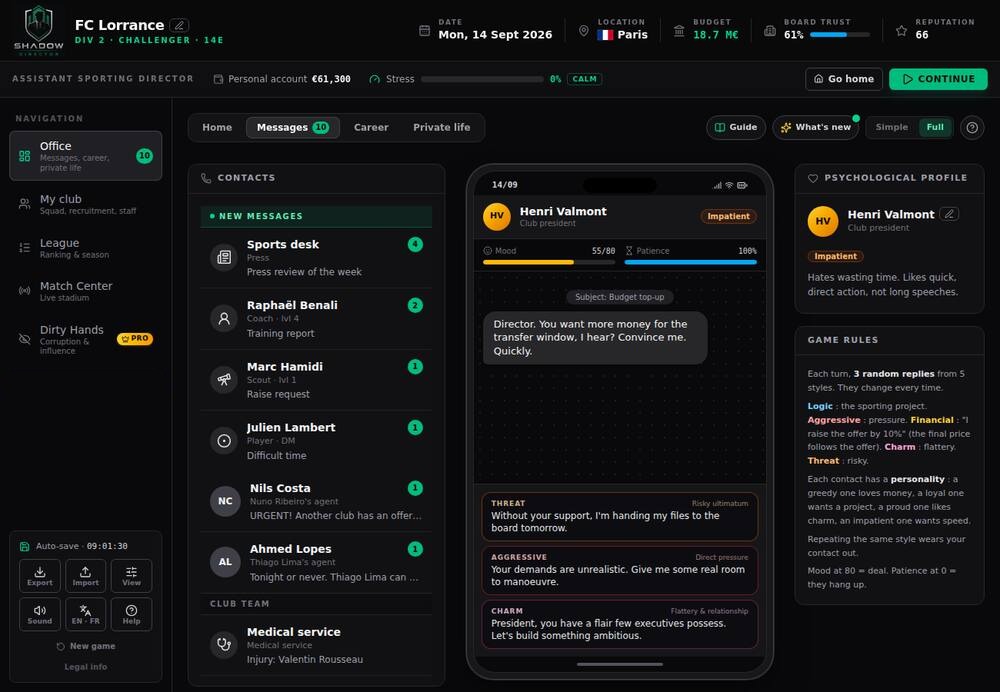
The five registers
| Register | Idea | Risk |
|---|---|---|
| Logic | Arguments on value, project, playing time | Can feel cold with an emotional agent |
| Aggressive | Impose a price, show you can walk away | Can put the other side’s back up |
| Financial | Talk wages, bonuses, length | Costs a lot if you give in too fast |
| Charm | Flatter, praise the player and club | Ineffective with a very pragmatic agent |
| Threat | Mention an alternative or leaving | Dangerous: can end the talks |
There is no always-winning reply. The game rewards observation: an agent who keeps coming back to money needs a different answer from one who talks ambition.
Going in person to negotiate better
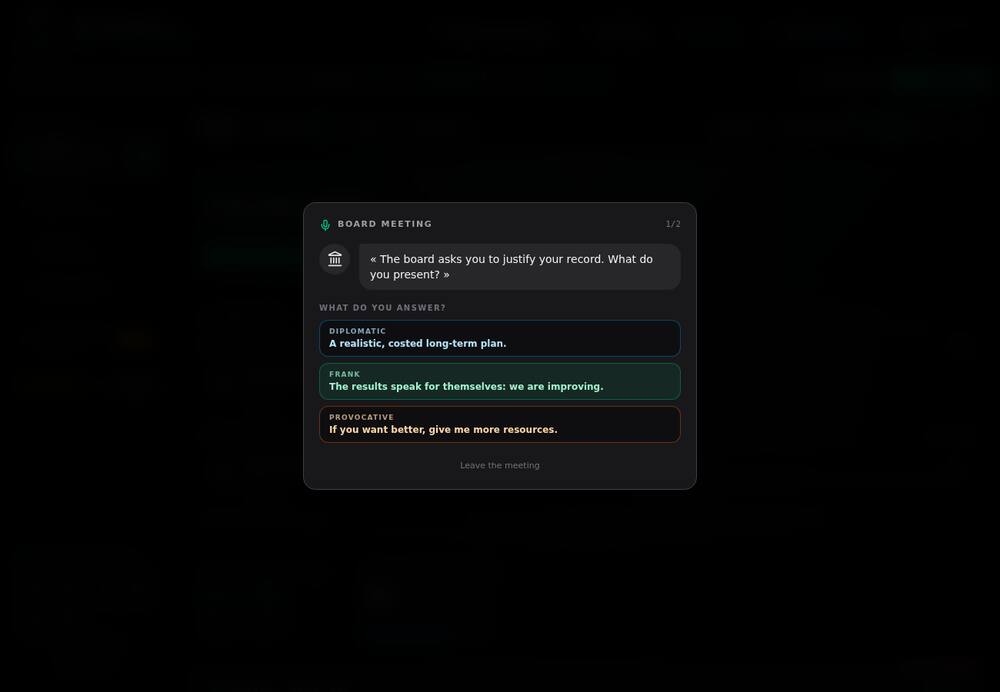
Part of the talks can be played face to face: the game offers meetings with the agent (among 8 meeting types, in two steps). A meeting affects board trust, the coach, morale and the budget. Going shows interest but costs time, hence energy: your stress is a resource to manage.
During the window and Deadline Day
The closer the end of the window, the higher the pressure. On Deadline Day urgent agent messages arrive: an available player, a falling price, an offer for one of yours. This is when a slow negotiation costs an opportunity and a rushed one can cost a lot.
Agents on sales and extensions
Agents do not only appear on purchases. A player who wants a raise, more playing time or a move goes through his agent. Not answering has a price: the morale of the player or agent drops. Unanswered messages also add to your stress. It is better to answer, even briefly, than to leave a request hanging.
You can also write your own reply: in many messages the “Reply in writing…” option lets you phrase your sentence and choose its tone (friendly, neutral, aggressive). Conversations are linked: an answer can bring a new question.
Practical tips
- Check the budget and wage bill first: no point negotiating for a player you cannot pay.
- Switch registers if one approach fails, instead of repeating it.
- Keep an alternative in reserve: knowing you can walk away changes the tone.
- Do not sign just to close: a failed transfer weighs on board trust.
- After signing, talk to your coach: a player imposed without him can damage the relationship.
To complete
For the overall market: the transfer window explained. For the job: the sporting director. The game situations detail specific cases and the possible replies.
Frequently asked questions
What kinds of replies exist in negotiation?
Five: Logic, Aggressive, Financial, Charm and Threat, three offered each round.
Should I always pick the same reply?
No. Their effect depends on the agent’s personality.
What happens if I ignore an agent?
The morale of the player or agent drops and pending messages raise your stress.
Can I write my own reply?
Yes, in many messages, with a friendly, neutral or aggressive tone.